 Business · Management · Systems
Business Analysis & Strategy · Published: 7 November 2026
Should Your Budget Be Based on Your Ambitious Sales Target?
How boards can preserve ambitious growth targets without compromising financial discipline, accountability or liquidity.
In this article
AT A GLANCE
A company approves an ambitious sales budget, together with the additional marketing, distribution and other expenditure needed to achieve it.
Six months later, sales are falling short. But much of the expenditure has already been incurred or committed.
Should the company have separated its realistic financial budget from its more ambitious sales target?
As businesses review their annual plans, this question deserves boardroom attention.
Traditionally, the sales target becomes part of the approved financial budget. That provides a common performance commitment, aligns departmental plans and establishes accountability. But it carries a risk: the additional revenue may not materialise, while the expenditure approved to achieve it has already been incurred.
This article considers two alternatives:
Option A: a Base Budget with a separate Growth Programme. Suited to growth that comes from distinct initiatives whose sales and costs can be identified and monitored.
Option B: two complete financial budgets. A realistic Base Budget and a more ambitious Target Budget, each with its own income statement, balance sheet and cash-flow projections. One set of actual results is compared against both.
Neither option asks the board to abandon its ambition. Both require a clear distinction between routine operating expenditure and material additional commitments to pursue the target. The latter may be authorised in advance or in stages, subject to evidence, timing and financing.
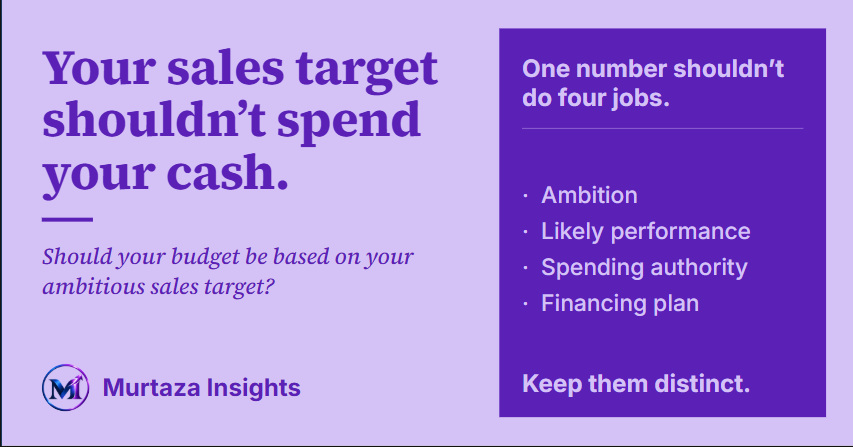
The objective is to stop one number from having to represent ambition, likely performance, spending authority and financing capacity all at once.
WORTH EXPLORING
- Can a business budget realistically without reducing management’s ambition?
- Should growth expenditure be approved unconditionally, or released against agreed milestones?
- Can two financial budgets improve board oversight without complicating accounting or weakening accountability?
ANALYSIS
1. Why sales targets usually become financial budgets
Annual budgeting generally begins with expected sales. Production, purchasing, staffing, marketing, distribution, working capital and financing plans are then built around those figures. When management adopts an ambitious target, the budget typically includes both the revenue and the resources needed to achieve it.
There are good reasons for this. Departments work towards a common objective. Management receives one integrated plan. Actual performance can be measured against an approved budget and deviations investigated.
The weakness is a mismatch between the certainty of expenditure and the uncertainty of revenue. A company may approve extra marketing campaigns, recruit salespeople, build inventory or expand distribution capacity in anticipation of higher sales. Much of that must be committed well before the revenue arrives. If sales disappoint, the expenditure may already be unavoidable.
The board must therefore distinguish between expenditure justified by reasonable operating expectations and additional commitments made in pursuit of more ambitious growth.
This does not mean the conventional single budget is wrong. It means its limitations should be understood, and alternatives considered where the growth is uncertain and the spending material.
2. The starting point: a realistic base and a strategic target
Consider an illustrative manufacturing business preparing its annual plan. All figures are illustrative.
| Sales planning measure | KSh million |
|---|---|
| Realistic base sales expectation | 540 |
| Additional growth ambition | 60 |
| Strategic sales target | 600 |
Management believes KSh 540 million is reasonable, given existing customers, demand, pricing, capacity and market conditions. It aims for KSh 600 million through additional marketing, wider distribution and customer development.
One possibility is to put the full KSh 600 million into a single budget, together with all the expenditure needed to achieve it. The alternatives below retain the ambition while separating it from the assumptions used for financial planning and the authority to make material additional commitments.
3. Option A: a Base Budget with a separate Growth Programme
This option suits growth from identifiable initiatives: a new product, a new geographical market, additional distributors or a new sales channel.
The board approves two connected components.
The Base Financial Budget is a complete operating and financial plan built on realistic sales, covering normal expenditure, profitability, working capital, financing and cash flow.
The Strategic Growth Programme is a separately approved programme designed to generate the additional KSh 60 million. It specifies:
- the commercial initiatives and expected incremental contribution;
- additional operating expenditure and any capital investment;
- accountable managers and implementation milestones;
- working-capital and financing requirements;
- the conditions for committing or releasing further expenditure.
Suppose the programme needs KSh 8 million of additional marketing. The board might approve the programme as a whole while distinguishing what must be committed now from what can wait:
| Expenditure | KSh million | Treatment |
|---|---|---|
| Initial phase | 3 | Approved for immediate commitment |
| Second phase | 3 | Released when agreed milestones are met |
| Further expansion | 2 | Requires fresh commercial justification |
| Total | 8 | Not all unconditionally authorised |
- Expenditure
- Initial phase
- KSh million
- 3
- Treatment
- Approved for immediate commitment
- Expenditure
- Second phase
- KSh million
- 3
- Treatment
- Released when agreed milestones are met
- Expenditure
- Further expansion
- KSh million
- 2
- Treatment
- Requires fresh commercial justification
- Expenditure
- Total
- KSh million
- 8
- Treatment
- Not all unconditionally authorised
Not all costs behave alike. Some must precede revenue. Others can be staged, reduced or cancelled if circumstances change.
The full programme must nevertheless remain inside the company’s integrated financial planning. Commitments and their expected cash flows cannot be left out merely because the growth initiative has its own budget.
Under Option A, the board report shows the Base Budget alongside the programme’s own scorecard: spend released against spend committed, leading indicators against milestones, and identifiable incremental sales against the KSh 60 million ambition. The overall sales target still appears in the same pack, so satisfactory base performance cannot mask a stalled programme.
Can the additional revenue and expenditure actually be identified?
Where initiatives involve distinct products, customer groups or markets, project codes, cost centres or analytical reporting may track the relevant sales and costs.
Even then, revenue associated with a campaign is not necessarily revenue caused by it. Some sales would have occurred anyway. Where marketing also supports existing products, salespeople serve old and new customers alike, or production and distribution resources are shared, separating incremental revenue and cost becomes increasingly subjective. Artificial allocations can produce misleading conclusions about a programme’s profitability.
Where attribution rests on too many assumptions, separating growth revenue from common expenditure may create more problems than it solves. That is when the second option becomes attractive.
4. Option B: two complete financial budgets
Instead of isolating the additional revenue and costs, management prepares two complete budgets:
The Base Budget: a realistic plan based on reasonable business expectations.
The Target Budget: a more ambitious but achievable plan, with the higher sales, the associated expenditure, profitability, working capital and financing requirements.
Both use consistent accounting classifications and reporting periods. Importantly, the company keeps only one set of actual accounting records. Actual sales are not divided into “base sales” and “target sales”, and common costs are not allocated arbitrarily between them. Actual results are simply compared against both approved budgets.
Option B resembles approaches in which a realistic planning case is monitored alongside a stretch or aspiration case. Here, both cases are complete financial plans, while authority for material incremental commitments is defined separately.
How would this appear in a board report?
Assume the following illustrative full-year position. The profit example assumes a 40% contribution margin on additional sales after sales-volume-related variable costs but before additional marketing, with other operating costs unchanged. Financing requirements are illustrative assumptions, not outputs of a constructed cash-flow model.
| Measure (KSh million) | Base Budget | Target Budget | Latest Forecast |
|---|---|---|---|
| Sales revenue | 540 | 600 | 555 |
| Marketing expenditure | 20 | 28 | 26 |
| Operating profit | 54 | 70 | 54 |
| Illustrative peak financing requirement | 70 | 95 | 82 |
- Measure (KSh million)
- Sales revenue
- Base Budget
- 540
- Target Budget
- 600
- Latest Forecast
- 555
- Measure (KSh million)
- Marketing expenditure
- Base Budget
- 20
- Target Budget
- 28
- Latest Forecast
- 26
- Measure (KSh million)
- Operating profit
- Base Budget
- 54
- Target Budget
- 70
- Latest Forecast
- 54
- Measure (KSh million)
- Illustrative peak financing requirement
- Base Budget
- 70
- Target Budget
- 95
- Latest Forecast
- 82
The board can read four things at once.
- Sales: the forecast is KSh 15 million above the Base Budget but KSh 45 million below the Target.
- Marketing: spending is KSh 6 million above the Base and KSh 2 million below the Target. Most of the extra marketing is being incurred.
- Profit: the extra contribution from additional sales (KSh 6 million) is fully absorbed by the additional marketing (KSh 6 million), so operating profit is no better than the Base and KSh 16 million below the Target.
- Financing: the assumed peak requirement is KSh 12 million above the Base. The illustration shows how the business might need more funding without a corresponding increase in forecast operating profit; the amount would need to be modelled before use in a real board decision.
This is the position the article warns about, and the board sees it before the year ends. The report does not prove that the marketing caused the extra sales. Whether the spending was commercially effective remains a management question requiring commercial evidence, contribution analysis and judgement.
A note on method. For year-to-date results, costs that move directly with activity—such as distribution costs or sales commissions—should also be compared with a budget flexed to the actual sales volume or other relevant cost driver. Forecast variable costs should separately be reassessed at projected future activity levels. This distinguishes activity-driven cost changes from genuine overspending without confusing actual variances with forward-looking forecasts.
The monthly pack should show year-to-date actuals against the phased budgets, alongside the latest full-year forecast against both original annual budgets. A forecast is not an actual result, and forecast revisions must never overwrite the approved benchmarks.
Advantages and risks
- The board sees both reasonable expectation and strategic ambition.
- Actual results are compared against both without artificial allocation of transactions.
- Growth-related expenditure is reflected in a complete Target Budget.
- The approach accommodates growth spread across existing products, customers and operations.
- Both budgets can be supported by integrated financing projections.
The principal cost is added planning and reporting discipline. Two budgets must not become two alternative explanations that management chooses between whenever performance disappoints. Both must be approved, consistently reported and used for their intended purposes.
5. Preventing an easy Base Budget, and keeping management accountable
This is the first objection most CFOs and MDs will raise, and it applies to both options. If management is judged mainly against the Base Budget, there is a temptation to understate revenue or overstate costs. A realistic budget must not become a deliberately undemanding one.
Evidence, not negotiation, should set the Base Budget. Useful safeguards include:
- comparing prior-year forecasts with actual results, and reporting the forecasting error;
- independent review of the sales pipeline, customer demand and capacity assumptions;
- cross-functional challenge, with finance, sales and operations testing one another’s assumptions;
- external benchmarks, where reliable ones exist;
- preserving the original approved budgets, so later forecast revisions never overwrite them.
Accountability also needs to be explicit. Management remains accountable for delivering the Base Budget, making progress towards the Target, and exercising spending discipline within approved authority while managing working capital and liquidity. Achieving the Base should not be confused with fulfilling the strategic ambition.
6. Authorising additional expenditure
Whichever option is chosen, a basic question remains: does approving the higher sales target automatically authorise all the expenditure associated with it?
It need not, and the board should say so explicitly.
The Base Budget should normally anchor routine expenditure and financial commitments. Ordinary variable costs may rise appropriately with actual sales under established limits and delegated authority. Material additional commitments to pursue the Target Budget—such as new campaigns, recruitment or capacity expansion—should be separately authorised, either upfront where justified or in stages against agreed conditions.
The two budgets then serve different purposes:
| Purpose | Governing plan or authority |
|---|---|
| Routine spending, procurement and activity-related variable costs | Approved operating budget, relevant activity levels and delegated authority |
| Facility sizing, lender negotiations and covenant testing | Integrated Base, Target and downside cash-flow scenarios |
| Management’s strategic objective | Target Budget |
| Material incremental spending to pursue the Target | Specific approvals and conditions, including advance commitments where commercially necessary |
Because the Target Budget is a complete financial plan, it shows what the business would need to spend and finance to reach its ambition. It does not, by itself, provide unconditional authority for material incremental spending.
The gap between the Base and Target Budgets should not be treated as uniformly discretionary. A useful classification is:
| Category | Characteristics | Board consideration |
|---|---|---|
| Committed | Contractual or practically unavoidable | Must be reflected in cash and financing forecasts |
| Staged | Released after agreed milestones | Progress and funding reviewed before release |
| Discretionary | Can be delayed, reduced or cancelled | Subject to continuing commercial justification |
- Category
- Committed
- Characteristics
- Contractual or practically unavoidable
- Board consideration
- Must be reflected in cash and financing forecasts
- Category
- Staged
- Characteristics
- Released after agreed milestones
- Board consideration
- Progress and funding reviewed before release
- Category
- Discretionary
- Characteristics
- Can be delayed, reduced or cancelled
- Board consideration
- Subject to continuing commercial justification
Inventory, hiring and capacity expansion may need different criteria from marketing, because their lead times and reversibility differ. The board should approve clear spending limits and delegations of authority for material incremental commitments.
What should trigger a release?
Releasing additional staged expenditure requires evidence that proceeding remains justified. Option B avoids forcing a precise attribution of revenue to individual initiatives, so triggers can rely on observable progress and leading indicators rather than artificial allocations:
- qualified pipeline value and conversion rates;
- orders secured or confirmed for later delivery;
- distributors appointed and actively ordering;
- new customers acquired against plan;
- sales run-rate against the phased Base Budget.
An illustrative trigger might read: “Release the second KSh 3 million marketing phase when the qualified pipeline reaches KSh 40 million and at least six of ten planned distributors are placing orders.” The board is then judging observable progress, not an allocation of shared revenue that nobody can verify.
This prevents the original danger: expenditure proceeding simply because it appears in an ambitious annual budget, after the assumptions behind it have changed. Budget approval, expenditure authority and financing availability are related, but separate, decisions.
7. Working capital and financing
A budget cannot be judged by its income statement alone. Additional sales may require more inventory, production capacity and customer credit before cash is collected, so successful growth can increase financing needs even as profit improves. Conversely, disappointing sales create liquidity pressure if customers pay slowly while inventory and committed expenses remain high.
Under either option, the company should prepare integrated projections covering profitability, balance-sheet movements and cash flow, and should examine a downside scenario.
Illustrative financing sensitivity
Assume the company has KSh 120 million of committed financing capacity for the requirements being modelled, subject to facility terms and covenants.
| Measure | Downside | Base | Target |
|---|---|---|---|
| Annual sales (KSh m) | 486 | 540 | 600 |
| Illustrative peak financing requirement (KSh m) | 105 | 70 | 95 |
| Illustrative minimum undrawn headroom (KSh m) | 15 | 50 | 25 |
- Measure
- Annual sales (KSh m)
- Downside
- 486
- Base
- 540
- Target
- 600
- Measure
- Illustrative peak financing requirement (KSh m)
- Downside
- 105
- Base
- 70
- Target
- 95
- Measure
- Illustrative minimum undrawn headroom (KSh m)
- Downside
- 15
- Base
- 50
- Target
- 25
The downside case is designed to reflect the article’s central risk. It assumes that inventory and expenditure have been committed at Target Budget levels, but sales reach only 90% of the Base Budget, collections take an additional 15 days, and some commitments cannot be reversed. Those conditions could produce a higher peak financing requirement than in the Target case, as the hypothetical figures illustrate.
These financing requirements are illustrative assumptions, not calculated outputs from an actual integrated cash-flow model. In a real business, the model would need to show the timing of inventory purchases, customer collections, supplier payments, expenditure and borrowing. Headroom in the table is KSh 120 million less the assumed peak requirement in each scenario.
The highest-sales scenario does not necessarily carry the greatest liquidity risk. Two features of the table deserve the board’s attention: the downside leaves only KSh 15 million of assumed undrawn headroom, and the Target case only KSh 25 million. Before commitments are made, the board should consider arranging additional facility capacity, tightening the triggers for releasing expenditure, or phasing inventory purchases against confirmed orders. Lender covenants should be tested against the downside, not just the Base.
The key questions are:
- What is the maximum cash requirement during the year, not merely at year-end?
- How much financing is needed before additional sales are collected?
- What happens if demand falls short or receivables take longer to collect?
- Are facilities sufficient and actually available under their contractual terms?
- What corrective actions remain possible if the forecast changes?
Under Option A, the growth programme’s financing needs must be consolidated with the Base Budget. Under Option B, both budgets carry their own working-capital and financing projections. Arranging additional borrowing capacity in advance may be prudent, but available financing should never by itself authorise additional expenditure.
8. What the accounting system needs to do
The accounting system does not need to keep separate actual financial records. The reporting structure needs to distinguish actual results from the approved planning alternatives.
Businesses with ERP systems. Depending on the product and its configuration, an ERP or integrated planning application may support multiple budget versions for the same period, budget-to-actual comparison for each version, analytical dimensions by department, product or project, updated forecasts, and expenditure commitments and controls. For Option A, project or campaign dimensions may help identify growth-related spend. For Option B, the system can hold Base and Target versions and compare the same actuals against both. These capabilities should be verified in the specific implementation, as some systems need additional configuration or planning software.
Businesses using other accounting packages. Sage, QuickBooks and similar products vary by edition and configuration; some already offer budgets and budget-versus-actual reports. The first step is to check the system’s existing capabilities. Where it cannot maintain or compare the required planning versions, a controlled Excel model may be the simplest supplement. The accounting system continues to record actuals, while the workbook holds the Base and Target Budgets, imports actual results, calculates variances against both, and carries rolling forecasts and financing scenarios. A properly designed workbook preserves original budget versions, documents assumptions, reconciles imported actuals and restricts unauthorised changes.
The priority is sound management reporting, not sophisticated software for its own sake. Excel may be sufficient for the missing comparisons; a change of accounting system or additional ERP planning functionality should be justified by the business’s actual requirements.
9. Which approach should a business choose?
There is no universally superior structure. The choice depends on the nature of the planned growth and the company’s reporting capability.
| Consideration | Option A: Separate Growth Programme | Option B: Two Complete Budgets |
|---|---|---|
| Nature of growth | Distinct initiatives, products, markets or channels | Growth spread across existing operations |
| Tracking incremental revenue | Feasible where initiatives are distinct and separable | Not required for variance reporting |
| Tracking expenditure | By identifiable programme or project | By comparing actual costs with both budgets |
| Financial planning | Base Budget plus consolidated growth assumptions | Complete Base and Target scenarios |
| Board reporting | Base performance and programme progress | Actuals and forecast against both budgets |
| Main difficulty | Attribution of shared revenue and costs | Managing two benchmarks and spending authority |
- Consideration
- Nature of growth
- Option A: Separate Growth Programme
- Distinct initiatives, products, markets or channels
- Option B: Two Complete Budgets
- Growth spread across existing operations
- Consideration
- Tracking incremental revenue
- Option A: Separate Growth Programme
- Feasible where initiatives are distinct and separable
- Option B: Two Complete Budgets
- Not required for variance reporting
- Consideration
- Tracking expenditure
- Option A: Separate Growth Programme
- By identifiable programme or project
- Option B: Two Complete Budgets
- By comparing actual costs with both budgets
- Consideration
- Financial planning
- Option A: Separate Growth Programme
- Base Budget plus consolidated growth assumptions
- Option B: Two Complete Budgets
- Complete Base and Target scenarios
- Consideration
- Board reporting
- Option A: Separate Growth Programme
- Base performance and programme progress
- Option B: Two Complete Budgets
- Actuals and forecast against both budgets
- Consideration
- Main difficulty
- Option A: Separate Growth Programme
- Attribution of shared revenue and costs
- Option B: Two Complete Budgets
- Managing two benchmarks and spending authority
Where growth initiatives are clearly identifiable, Option A may give better insight into their performance and return. Where additional growth is expected across established products, customers and operations, Option B may offer greater simplicity and transparency.
The options can also be combined. A company may run Option B for the business as a whole while applying Option A’s programme controls to one clearly identifiable initiative, such as a new distribution channel.
Some companies will reasonably keep a single ambitious budget, supported by stretch targets, rolling forecasts and conditional expenditure controls. That may be entirely appropriate where sales assumptions are well supported, financing is adequate and the associated expenditure is proportionate and reversible.
These alternatives are management options, not prescribed accounting or governance standards. Their purpose is to improve decisions, not to increase the volume of reporting.
CONCLUSION
Must a company’s sales target become its financial budget?
Not necessarily.
The single-budget approach has real advantages: it coordinates departmental plans, establishes commitments and provides a common benchmark. But where additional growth is uncertain and requires material expenditure, boards should consider distinguishing ambition from financial expectation more explicitly.
A simple decision guide can help. Where growth comes from distinct initiatives that can be tracked, consider a Base Budget with a separate Growth Programme. Where growth is spread across existing products, customers and operations, consider two complete budgets. Where assumptions are strong, expenditure risks are manageable and financing is adequate, a single ambitious budget may still be the right answer.
Whichever structure is chosen, three safeguards are useful:
- Routine spending follows the approved operating plan and delegated authority; material additional commitments made in pursuit of the target require explicit approval and suitable conditions, including upfront approval when necessary.
- A downside liquidity test is performed before material growth commitments are made, including a stress case with Target-level commitments and Base-or-lower sales where relevant.
- The strategic target stays visible in every board pack, together with the original approved financial benchmark(s) and the latest forecast.
The right choice reflects the reliability of the sales assumptions, the reversibility of spending and the strength of financing headroom.
The objective is not to produce more budgets. It is to prevent ambition, expected performance, spending authority and financing capacity from becoming indistinguishable.
As businesses review their planning approach, that distinction deserves a place in the boardroom.
Sources & References
The governance model proposed here is the author’s management recommendation. The sources below support individual points and do not endorse the model as a whole.
- ICAEW — Business Performance Management: Working with Tensions (2018) — Planning and forecasting tensions, budgetary slack, performance targets, scenario analysis and management accountability.
- ICAEW — Assessing the Reliability of a Forecast (2023) — Evidence-based forecasts and uncertainty. Some content requires member access.
- ICAEW — Cash Flow Forecasts and Inventory — Inventory, receivables, expenditure commitments and cash-flow forecasting.
- ICAEW — Nine Principles for Finance Professionals — Cash forecasting, scenario analysis, financing headroom and reporting controls.
- AICPA & CIMA — Rolling Plans and Forecasts — The role of rolling forecasts in keeping an updated view of expected performance.
- Microsoft Learn — Create G/L Budgets in Business Central — An example of an ERP supporting multiple budgets, dimensions and Excel integration; capabilities vary by system.
- ACCA — All About Budgeting, Part 1 — Cost behaviour and flexible-budget analysis, as used in the flexed-budget note in section 4.
WORK WITH ME
Many boards approve budgets without being clear which number governs spending, which goes to the bank, and which management is held to.
Businesses reviewing their budgeting approach, expenditure controls or board reporting can discuss a scoped remote Business Analysis & Strategy assignment with Murtaza Insights.
© 2026 Murtaza Insights
More from Business Analysis & Strategy

Business Analysis & Strategy · Last updated: 13 October 2026
Quickmart IPO: Valuation, Returns and Investment Risks
Quickmart is growing, profitable and attracting major investors. But at KSh7.50, does the potential return justify the risks? A closer look at the valuation, dividends, growth plans and IPO structure.
Read Article
Business Analysis & Strategy · Last updated: 2 November 2026
Why Kylian Mbappé Left Nike for On: The Shift to Equity
Mbappé’s move from Nike to On combines cash, equity and product influence. Explore the wider business lessons about turning a celebrity endorsement into ownership.
Read ArticleMore Insights

Business Performance Reviews · Last updated: 13 October 2026
Can Cutting Prices Improve Your Business Performance?
Explore how lower prices can improve business performance when a second change helps you reach and serve more customers economically, using Simbisa as an example.
Read Article