 Business · Management · Systems
Business Analysis & Strategy · Last updated: 13 October 2026
Quickmart IPO: Valuation, Returns and Investment Risks
Quickmart is growing, profitable and attracting major investors. But at KSh7.50, does the potential return justify the risks? A closer look at the valuation, dividends, growth plans and IPO structure.
In this article
Quickmart is one of Kenya’s largest supermarket businesses. It has scale, growing profits and ambitious expansion plans.
But a good company is not automatically a good investment at any price.
So, does Quickmart’s IPO at KSh7.50 offer investors an attractive return for the risks involved?
AT A GLANCE
- The business: Quickmart has grown to 72 stores, with annual revenue exceeding KSh50 billion and rising profits. But supermarket margins remain thin.
- The valuation: KSh7.50 values Quickmart at KSh30 billion — approximately 20 times reported FY2025 earnings, or 17.6 times adjusted earnings. On management's FY2026 profit forecast, the reported-earnings multiple falls to about 14.3 times, below the 17.2 times average for selected international grocery retailers. But the forecast requires approximately 39% profit growth.
- The dividend: The targeted FY2026 dividend of approximately KSh0.50 per share produces an estimated net yield of 6.3% for a qualifying resident investor, below the referenced 364-day Treasury bill yield of approximately 7.7% net.
- The growth requirement: The lower initial income yield could be offset by dividend and share-price growth. But Quickmart must deliver substantial improvements in profitability to support that prospect.
- The cash question: Quickmart plans further expansion while targeting very high dividend distributions. Dividends, new stores and working-capital requirements all compete for cash.
- The IPO structure: Investors are buying existing shares. The IPO proceeds go to the selling shareholder, not into Quickmart to fund expansion.
- The additional selling risk: Following a fully subscribed IPO, 800 million retained shares — representing 20% of Quickmart — would be outside the 24-month lock-up, potentially creating additional market supply.
BOTTOM LINE
Quickmart may be a good business. But at KSh7.50, I do not think the prospective return adequately compensates me for the risks I would be taking.
1. The dividend does not compensate me sufficiently
Quickmart is targeting approximately KSh2 billion of dividends for FY2026. With four billion shares outstanding, that represents approximately KSh0.50 per share.
At KSh7.50, the prospective gross dividend yield is approximately 6.7%. After 5% withholding tax applicable to qualifying resident investors, the prospective net dividend yield is approximately 6.3%, assuming the targeted dividend is declared.
That is not unattractive in isolation. But investments do not exist in isolation.
The referenced 364-day Kenya Treasury bill offers approximately 7.7% net. So I would be accepting the risks of an equity investment while initially receiving less income than from a government security.
Figure 1. Indicative Annual Income Yields
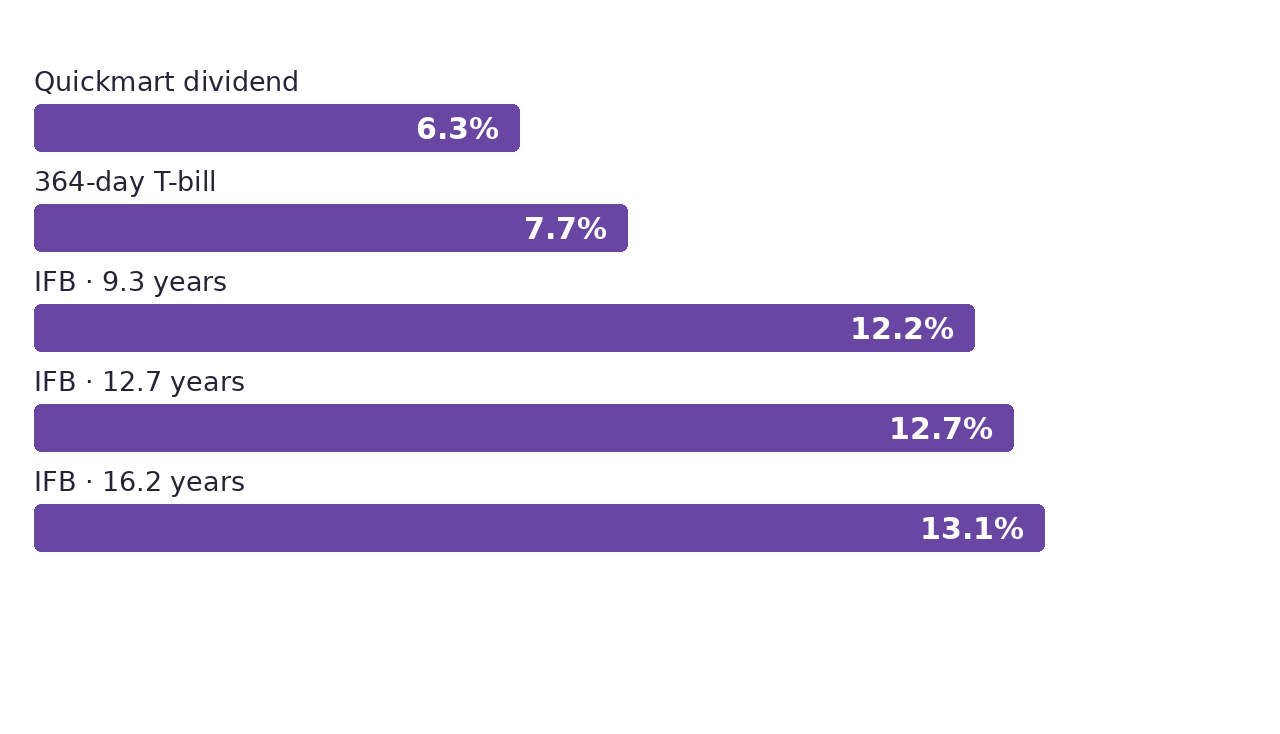
Quickmart's yield is a prospective net dividend yield, not guaranteed. The Treasury bill figure is the referenced approximate net yield. Infrastructure bond figures are historical accepted yields from the August 2026 auction, with remaining maturities shown at that time. They are not current quotations. The instruments differ in maturity, liquidity, capital risk and certainty of income.
The infrastructure bond comparison is particularly interesting.
Kenya's August 2026 tax-exempt infrastructure bond auction recorded accepted weighted-average yields of 12.196%, 12.688% and 13.052%, for bonds with approximately 9.3, 12.7 and 16.2 years remaining to maturity at the auction date.
Those are historical returns available at the auction, not necessarily the yields at which investors could buy the bonds today. Their much longer maturities also expose investors to different liquidity, interest-rate and market-price risks.
Nevertheless, the comparison illustrates why investors seeking income should examine alternatives before committing to an equity investment.
This does not mean Quickmart shares cannot outperform government securities. They certainly could.
But the difference has to come from somewhere else.
It has to come from growth.
2. At KSh7.50, how much future growth am I paying for?
At KSh7.50 per share and four billion shares in issue, Quickmart is valued at KSh30 billion.
Against reported FY2025 net profit of approximately KSh1.51 billion, that represents about 19.9 times earnings. Using adjusted profit after tax of approximately KSh1.7 billion reduces the multiple to about 17.6 times.
But the valuation looks different when management's FY2026 forecast is considered.
Management projects revenue of approximately KSh58.2 billion and profit after tax of about KSh2.10 billion for FY2026.
If achieved, the KSh30 billion valuation would represent approximately 14.3 times FY2026 reported earnings rather than 19.9 times historical reported earnings.
That is a meaningful difference.
Historical performance versus forecast
| Measure | FY2025 actual | FY2026 forecast |
|---|---|---|
| Revenue | KSh50.43bn | KSh58.20bn |
| Profit after tax | KSh1.51bn | KSh2.10bn |
| Net profit margin | 3.0% | 3.6% |
| P/E at KSh7.50 | 19.9× | 14.3× |
- Measure
- Revenue
- FY2025 actual
- KSh50.43bn
- FY2026 forecast
- KSh58.20bn
- Measure
- Profit after tax
- FY2025 actual
- KSh1.51bn
- FY2026 forecast
- KSh2.10bn
- Measure
- Net profit margin
- FY2025 actual
- 3.0%
- FY2026 forecast
- 3.6%
- Measure
- P/E at KSh7.50
- FY2025 actual
- 19.9×
- FY2026 forecast
- 14.3×
Note: FY2026 figures are Quickmart management forecasts, not actual results.
There is also an international comparison.
Stanbic's official offer-pricing analysis identifies an average estimated FY2026 P/E multiple of 17.2 times and a median of 17.7 times for selected international grocery retailers.
It also places Quickmart's own FY2026 price-to-adjusted-earnings multiple at approximately 12.9 times, using forecast adjusted earnings of approximately KSh2.32 billion. That is a different earnings measure from the approximately 14.3 times multiple calculated using forecast reported profit.
By either measure, Quickmart's forward multiple is below the selected international peer average.
That is a point in Quickmart's favour.
However, these companies operate in different markets, with different risk profiles, funding conditions, growth prospects and investor expectations. Their multiples cannot automatically be transferred to a Kenyan supermarket business.
The more important question: can Quickmart deliver the forecast?
Quickmart reported approximately KSh873 million of profit in the first six months of 2026.
To achieve management's full-year target of approximately KSh2.10 billion, it would therefore need to earn about KSh1.23 billion in the second half.
That is roughly 41% more profit in the second half than in the first.
This is not impossible. Retailers can experience seasonal differences, and operational improvements may contribute to earnings growth.
But it highlights the importance of execution.
Quickmart must deliver approximately 39% annual profit growth while increasing its net margin from about 3.0% to 3.6%, assuming it achieves the forecast revenue.
The forward valuation is therefore more attractive than the historical multiple suggests. But its attractiveness depends on the forecast improvement actually materialising.
I would want convincing evidence of that improvement before paying today for tomorrow's earnings.
3. Supermarket growth does not automatically mean profit growth
Quickmart reported approximately KSh50.43 billion of revenue in FY2025, while reported net profit was approximately KSh1.51 billion.
That implies a net margin of only about 3%.
This is not necessarily a criticism of Quickmart. Supermarkets are inherently high-volume, thin-margin businesses.
But it matters enormously to an investor.
When margins are this narrow, relatively modest changes in operating costs, pricing, inventory losses, supplier terms or efficiency can have a disproportionate effect on profits.
A supermarket can increase its sales substantially without achieving a corresponding increase in profits.
Quickmart has demonstrated impressive growth. For me, the question is whether future expansion will produce enough additional profit and cash — rather than simply additional turnover — to justify today's valuation.
4. I am uncomfortable with the combination of expansion and very high dividends
Quickmart intends to keep expanding.
At the same time, its intended dividend payout is approximately 95% of profit after tax in FY2026, 90% in FY2027 and at least 80% thereafter, subject to profitability, cash requirements and board approval.
As a shareholder, a generous dividend sounds attractive.
As an analyst, I have to ask where the cash for growth will come from.
Quickmart's operating model helps answer that question.
Customers generally pay immediately, while suppliers are paid later. As at June 2026, Quickmart reported structurally negative working capital of approximately KSh4 billion and only KSh6.8 million of conventional borrowings.
That can be an efficient supermarket financing model.
But it also means that cash generation, inventory turnover and supplier terms remain important.
Figure 2. Quickmart’s Intended Dividend Payout Ratios
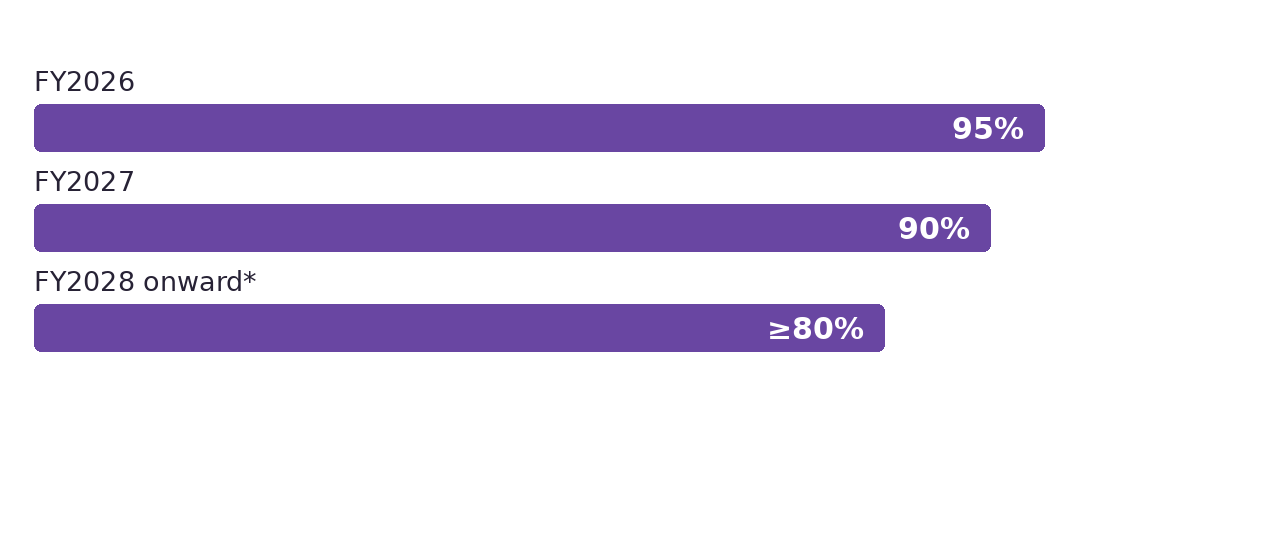
*At least 80% from FY2028 onward. These are policy targets, subject to profitability, cash requirements and board approval.
If Quickmart is going to expand aggressively and distribute most of its profits, I would want considerable confidence that those cash dynamics remain favourable.
At KSh7.50, I do not think I am being given enough margin for that uncertainty.
5. None of my KSh7.50 goes into Quickmart
This IPO does not raise new equity capital for Quickmart.
The two billion shares being offered already exist.
If fully sold at KSh7.50, gross proceeds would be KSh15 billion, with estimated net proceeds of approximately KSh14.4 billion going to Sokoni Retail Kenya, the selling shareholder.
There is nothing inherently wrong with an existing shareholder realising part of its investment.
But it changes how I view the proposition.
My investment would buy an interest in the existing business. It would not inject fresh capital into Quickmart to finance the expansion on which part of my prospective return depends.
Future growth therefore has to be financed principally through Quickmart's own cash generation and other available funding.
That makes the previous question about dividends, working capital and expansion even more relevant.
6. IFC’s investment is reassuring — but it doesn’t change my price
IFC has conditionally agreed to invest approximately KSh1.94 billion, potentially acquiring around 6.45% of Quickmart at the same KSh7.50 price.
I regard that as positive.
IFC has resources and due-diligence capabilities far beyond those of an individual retail investor.
But IFC and I do not necessarily have the same investment objectives, time horizon, portfolio or appetite for risk.
Its participation gives me greater confidence in the company and the transaction.
It does not establish that KSh7.50 offers the return I require.
7. Kenya’s supermarket history makes me cautious about cash
Quickmart is not Nakumatt, Tuskys or Uchumi.
It operates under different ownership and management, and it should be judged on its own merits.
Nevertheless, Kenya's supermarket history provides a useful warning.
Large sales numbers and rapid expansion do not protect a retailer if working capital, suppliers, cash flow, governance or expansion economics deteriorate.
That is why, if I were a shareholder, I would watch Quickmart's cash generation, supplier balances, inventory turnover and returns from new stores at least as closely as its headline revenue growth.
8. Could another 800 million shares come onto the market?
There is another reason for my caution: the possibility of additional shares being sold after listing.
If the IPO is fully subscribed, Sokoni Retail Kenya will retain two billion shares.
Only 60% of that remaining holding — 1.2 billion shares — is subject to a 24-month lock-up, subject to the stated exceptions.
The remaining 800 million shares, equivalent to 20% of Quickmart's issued share capital, would therefore be outside that lock-up.
At the IPO price of KSh7.50, they have an indicative value of KSh6 billion.
No additional sale has been announced. The absence of a lock-up does not mean the shares will be sold.
Nevertheless, a sizeable future sale could put pressure on the market price or constrain potential appreciation if investor demand does not absorb the supply.
It could also improve trading liquidity. Because these are existing shares, such a sale would not dilute shareholders.
At KSh7.50, that potential selling overhang is another risk I must weigh against the prospective return.
So why am I not buying?
It is not because I think Quickmart is a bad company.
Quite the opposite.
It is already a substantial Kenyan consumer business, with more than KSh50 billion in annual sales, growing profits, little conventional borrowing, expansion potential and the reassurance of IFC's proposed investment.
Its forward earnings valuation also compares reasonably with selected international supermarket peers.
My issue is the return I require for the risks involved.
The prospective dividend yield is below the referenced Treasury bill. The more attractive forward valuation depends on substantial earnings growth. And expansion, high dividend payouts and working-capital requirements place competing demands on cash.
The IPO provides no fresh capital to finance that expansion, while the possibility of additional shares being sold after listing introduces another consideration.
None of these risks makes Quickmart uninvestable.
But together, they affect the price I am prepared to pay.
My decision
I am not applying for Quickmart shares at KSh7.50.
That is a decision about price and the return I require — not a prediction that Quickmart will perform badly or that its share price will fall after listing.
What would change my mind?
At a prospective dividend of KSh0.50 per share, the net dividend after 5% withholding tax would be approximately KSh0.475.
At a share price of approximately KSh6.20, that would produce a net yield of about 7.7%, broadly matching the referenced 364-day Treasury bill.
But matching the income return alone would not compensate me for equity risk.
I would still want a lower price, or convincing evidence that sustained earnings growth and cash generation could support the dividend policy and justify the valuation.
A good company and a good investment are not necessarily the same thing.
And a good investment at one price may not be a good investment at another.
What Quickmart’s IPO Tells Business Owners and Suppliers
The investment decision ends above. But Quickmart's IPO also provides useful lessons for people who may never buy a single Quickmart share.
Suppliers: Watch the Balance of Power
Quickmart's negative working-capital model illustrates why supplier credit is valuable to a large retailer.
The retailer can sell goods and collect cash before paying the supplier. That reduces the amount of its own capital tied up in working capital.
For suppliers, however, the same arrangement means that their balance sheets are helping finance the retailer's operations.
As Quickmart grows, suppliers may benefit from larger volumes.
But they should watch payment periods, concentration of sales with one customer, margins and the amount of working capital required to support that growth.
Three questions are particularly important:
- What proportion of your sales and receivables depends on one major retailer?
- How many days does that retailer take to pay, and is that period increasing?
- Could your business absorb slower payments or tighter commercial terms without disrupting its own operations?
More sales are not necessarily better business if they require disproportionately more financing.
Business Owners: Profit and Cash Are Different Things
Quickmart also illustrates a broader lesson.
A company can be profitable and growing while still needing careful management of cash.
Expansion, dividends, inventory and supplier payments all ultimately compete for liquidity.
For any growing business, therefore, the question should not simply be: Are profits increasing?
It should also be: Where is the cash coming from, where is it going, and can the business continue financing its growth without creating financial strain?
That question applies far beyond supermarkets.
Disclosure: I do not hold shares in Quickmart and am not applying for shares in its IPO.
Disclaimer: This article is business analysis and commentary for general information. It is not personal investment advice.
Source Documents
- Quickmart IPO Information Memorandum — financial results, forecasts, dividend policy, offer structure and lock-up terms (official IPO website: https://ipo.quickmart.co.ke/).
- Quickmart Offer Price Valuation Parameters (Stanbic, October 2026): https://ipo.quickmart.co.ke/wp-content/uploads/2026/10/Quick-Mart-PLC-Offer-Price-Valuation-Parameters_2026.10.04_vCirc.pdf
- Central Bank of Kenya — 364-day Treasury Bill Auction Results, 8 October 2026: https://www.centralbank.go.ke/
- Central Bank of Kenya — August 2026 Infrastructure Bond Auction Results: https://www.centralbank.go.ke/
- Quickmart FY2025/H1 2026 financial information: FY2025 revenue KSh50.43bn; reported PAT KSh1.51bn; adjusted PAT KSh1.71bn; June 2026 borrowings KSh6.8m; structurally negative working capital about KSh4bn.
Looking for an independent perspective on business performance, strategy or systems improvement?
© 2026 Murtaza Insights
More from Business Analysis & Strategy
Business Analysis & Strategy · Published: 7 November 2026
Should Your Budget Be Based on Your Ambitious Sales Target?
How boards can preserve ambitious growth targets without compromising financial discipline, accountability or liquidity.
Read Article
Business Analysis & Strategy · Last updated: 2 November 2026
Why Kylian Mbappé Left Nike for On: The Shift to Equity
Mbappé’s move from Nike to On combines cash, equity and product influence. Explore the wider business lessons about turning a celebrity endorsement into ownership.
Read ArticleMore Insights

Business Performance Reviews · Last updated: 13 October 2026
Can Cutting Prices Improve Your Business Performance?
Explore how lower prices can improve business performance when a second change helps you reach and serve more customers economically, using Simbisa as an example.
Read Article