 Business · Management · Systems
Business Performance Reviews · Last updated: 13 October 2026
Can Cutting Prices Improve Your Business Performance?
Sometimes it can — if another change helps you handle the extra volume

In this article
AT A GLANCE
Cutting prices can improve profits—but only if the extra sales contribute enough to offset the lower margin and any additional operating costs. Spare capacity can help; higher sales alone are not enough.
Simbisa Kenya illustrates how lower average customer spending can coincide with higher volumes and improved profitability.
There is also another option beyond cutting prices—explored below.
1. Lower Spend, but Many More Customers
The conventional view is that reducing prices means sacrificing profit. That is often true—but not always. A smaller contribution on each sale can produce a better overall result if enough additional sales follow and the business can serve those customers economically.
Simbisa Kenya’s FY2026 results provide an interesting illustration:
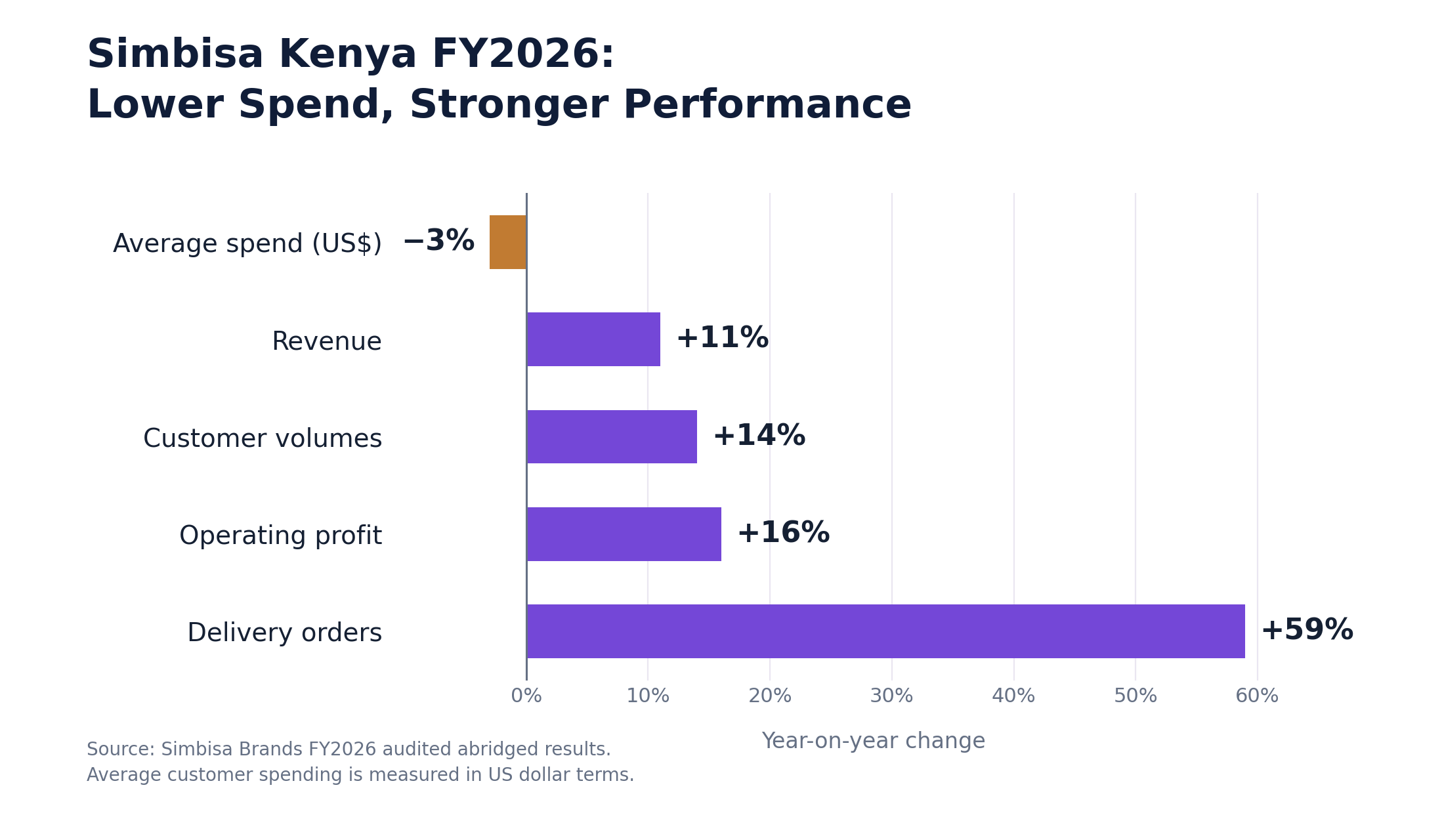
Kenya faced pressure on household incomes and strong competition. Simbisa responded with value-focused offerings, promotions and additional value meals, aiming to stimulate customer traffic and defend market share.
Although customers spent less on average, the increase in customer volumes more than compensated, producing revenue growth of 11%. More importantly, operating profit grew faster than revenue.
Lower average spending does not, however, establish that menu prices were uniformly reduced: product mix, promotions and customer choices can also affect the average transaction value.
The central business question remains: can a lower selling price attract sufficient additional demand to improve overall profits?
2. How Much Extra Volume Would You Need?
The answer depends on contribution—the amount remaining from each sale after deducting the variable costs of producing and serving it. Contribution covers fixed costs, such as rent and permanent staffing, before anything remains as profit.
A price reduction lowers contribution per unit. The business must therefore sell more units merely to maintain its previous total contribution.
Consider a product selling for KSh100, with variable costs of KSh70:
| Before price cut | After a 3% price cut | |
|---|---|---|
| Selling price | KSh100 | KSh97 |
| Variable cost | KSh70 | KSh70 |
| Contribution per unit | KSh30 | KSh27 |
| Units needed to preserve KSh3,000 contribution | 100 | 111.1, rounded up to 112 whole units |
- Selling price
- Before price cut
- KSh100
- After a 3% price cut
- KSh97
- Variable cost
- Before price cut
- KSh70
- After a 3% price cut
- KSh70
- Contribution per unit
- Before price cut
- KSh30
- After a 3% price cut
- KSh27
- Units needed to preserve KSh3,000 contribution
- Before price cut
- 100
- After a 3% price cut
- 111.1, rounded up to 112 whole units
The business needs approximately 11.1% more unit sales just to maintain its original contribution. Sales above that level can improve profits, provided additional costs do not offset the gain.
Required volume increase = Price cut % ÷ (Current contribution margin % − Price cut %)
Both percentages are measured against the original selling price. The formula assumes the price cut is smaller than the current contribution margin.
Additional Sales Volume Required to Maintain Current Total Contribution
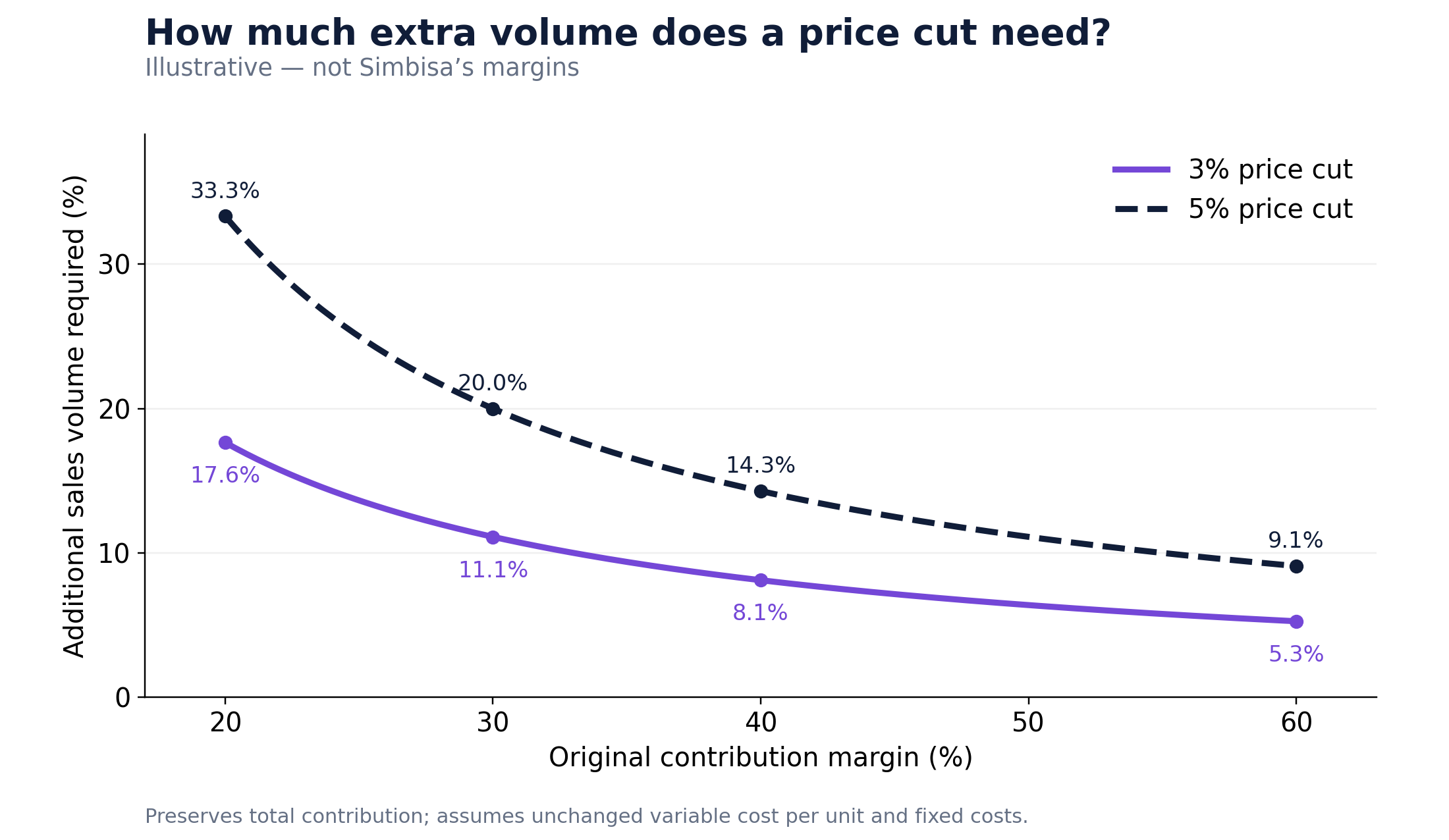
Illustrative only; not Simbisa’s margins. Assumes unchanged variable cost per unit and unchanged fixed costs.
The thinner the current contribution margin, the more additional sales a price cut requires. For a 3% cut, a current contribution margin of 30% requires approximately 11.1% extra unit sales to maintain total contribution.
Simbisa Kenya’s 14% growth in customer volumes offers an interesting comparison, but customer counts are not necessarily units sold, and average customer spending reflects changes in product mix as well as pricing.
The chart is a business-planning illustration, not a calculation of Simbisa’s actual pricing economics.
3. Can You Serve the Extra Business Economically?
More volume is only part of the equation. The cost of handling those additional sales can determine whether the strategy succeeds.
Consider two manufacturers offering the same price reduction. One operates with spare production capacity and can process extra orders using existing machinery, premises and staffing. The other is already close to capacity and must add overtime, shifts or equipment. Their sales growth might be identical, but their profit outcomes could differ substantially.
Spare capacity can make a price reduction more attractive because additional sales may be accommodated without a proportionate increase in fixed costs.
Simbisa Kenya added five net stores and ended FY2026 with 257. Customer growth of 14% against roughly 2% net growth in its network suggests more intensive use of existing outlets. Store-opening dates and outlet-level contributions have not been disclosed, so this is an indication rather than proof of the source of profit growth.
There is also a cash requirement. Manufacturers and distributors may need more stock and longer credit to support higher volumes. A strategy can improve operating profit while putting pressure on working capital and cash flow.
4. Another Route to the Customer
Simbisa Kenya’s delivery orders increased 59% during FY2026. Its FY2026 analyst presentation reports delivery at approximately 27% of Kenya’s turnover. That is delivery’s share of sales, not its contribution after costs.
Delivery can extend customer reach without requiring every buyer to visit an outlet—or the business to open a new one.
Existing third-party platforms, such as Glovo, illustrate the opportunity to use established delivery infrastructure rather than building an extensive operation from scratch. Such arrangements may reduce the need for large fixed investments, although they bring transaction-related expenses.
Simbisa’s third-quarter trading update mentions growth through both its own delivery operation and third-party partnerships. That update does not name the partners, so Glovo is used here as an illustrative example.
Platform commissions, packaging, fulfilment costs, returns and business-funded discounts matter when assessing incremental contribution.
Simbisa’s reported profit already reflects delivery costs it incurred; those costs should not be deducted again from its reported results. However, the disclosures reviewed do not separately quantify Kenya’s delivery costs or profitability, or establish their allocation between cost of sales and operating expenses.
The same principle applies beyond restaurants: manufacturers, wholesalers and service businesses can use distributors, agents, resellers or marketplaces to reach new customers through existing external capacity.
The opportunity is to generate profitable additional sales through more intensive use of existing internal capacity and established external distribution channels.
5. So, Can Cutting Prices Improve Profits?
Yes—but only when the additional contribution from increased sales exceeds the margin sacrificed through lower prices and any additional costs incurred.
Simbisa Kenya illustrates how lower average customer spending can coexist with higher customer volumes, stronger revenue and increased operating profit.
Its reported profitability improved after recorded costs, but the disclosures do not isolate the contribution of pricing and delivery to that improvement. Simbisa attributes the faster profit growth to cost management and operating efficiencies.
For another business, three questions determine whether the strategy makes sense:
- Volume: Will the reduction attract enough genuinely additional sales?
- Capacity: Can the business absorb extra demand without disproportionate cost increases?
- Contribution: Will the additional sales generate more total contribution after all incremental costs?
A price cut should therefore be evaluated as an investment in additional demand, with a measurable financial return.
The objective is not simply to sell more. It is to earn more.
6. Is Cutting Prices the Only Option?
Not necessarily. Simbisa’s Zimbabwe operations illustrate another approach. In FY2026, customer volumes and average spending each rose 11%, revenue increased 23%, and operating profit grew 39%.
Its reported initiatives included:
- Better products: Improved food quality, new product development and basket meal offerings.
- Better service: Enhanced service standards and customer experience.
- Targeted promotions: Day-specific offers and value campaigns, rather than relying solely on broad price reductions.
- Expanded delivery: Orders increased 75% over the year, with delivery helping support higher average spending.
- Network improvements: Seventeen net new stores and six refurbishments.
- Operating efficiencies: Procurement savings, productivity improvements and cost controls.
Zimbabwe’s growth illustrates the possibility of attracting more customers and increasing their spending through a combination of better products, service, convenience and efficiency. This was not a promotion-free strategy, and higher average spending does not imply that every menu price stayed unchanged.
The two markets faced different challenges: Zimbabwe contended with a Fast-Food Tax and intermittent power disruptions, while Kenya faced pressure on household incomes and political unrest.
Their results are therefore not directly comparable, but the contrasting approaches illustrate an important choice: reducing prices is one option, not necessarily the most profitable one.
7. What Would Work in Your Business?
Before committing to lower prices, owners and executives should consider:
- What additional volume would be required to preserve—and then increase—total contribution?
- Can existing capacity absorb the extra sales without substantial new costs?
- Will sales be genuinely additional, or will existing customers simply pay less?
- What will be the effect on working capital and cash flow?
- Could better products, service, availability or distribution deliver a stronger result?
- How might competitors and customers react, and could the price cut be reversed if the extra volume does not materialise?
A controlled trial can help establish the answers. Measure incremental contribution, genuinely additional business, capacity demands and cash requirements rather than judging success from revenue alone.
Could Targeted Changes Improve Your Performance?
An independent Business Performance Review can examine pricing choices, customer demand, operating capacity and distribution together—helping management evaluate opportunities and trade-offs before making significant changes.
Source Documents
- Simbisa Brands — Audited Abridged Financial Results for the year ended 30 June 2026, published 29 September 2026.
- Simbisa Brands — FY2026 Analyst Briefing Presentation, published 29 September 2026.
- Simbisa Brands — Trading Update for the Third Quarter ended 31 March 2026, published 15 May 2026.
Contribution examples, chart and capacity implications are illustrative editorial analysis.
Looking for an independent perspective on business performance, strategy or systems improvement?
© 2026 Murtaza Insights
More from Business Performance Reviews
More articles in this category will appear here as they are published.
More Insights
Business Analysis & Strategy · Published: 7 November 2026
Should Your Budget Be Based on Your Ambitious Sales Target?
How boards can preserve ambitious growth targets without compromising financial discipline, accountability or liquidity.
Read Article
Business Analysis & Strategy · Last updated: 13 October 2026
Quickmart IPO: Valuation, Returns and Investment Risks
Quickmart is growing, profitable and attracting major investors. But at KSh7.50, does the potential return justify the risks? A closer look at the valuation, dividends, growth plans and IPO structure.
Read Article
Information Systems & Process Improvement · Last updated: 13 October 2026
Don’t Invent It. Technify It.
Many new technology ideas begin with old business practices. Explore how AI and software can remove their limitations and create practical opportunities for your business.
Read Article