 Business · Management · Systems
Information Systems & Process Improvement · Last updated: 13 October 2026
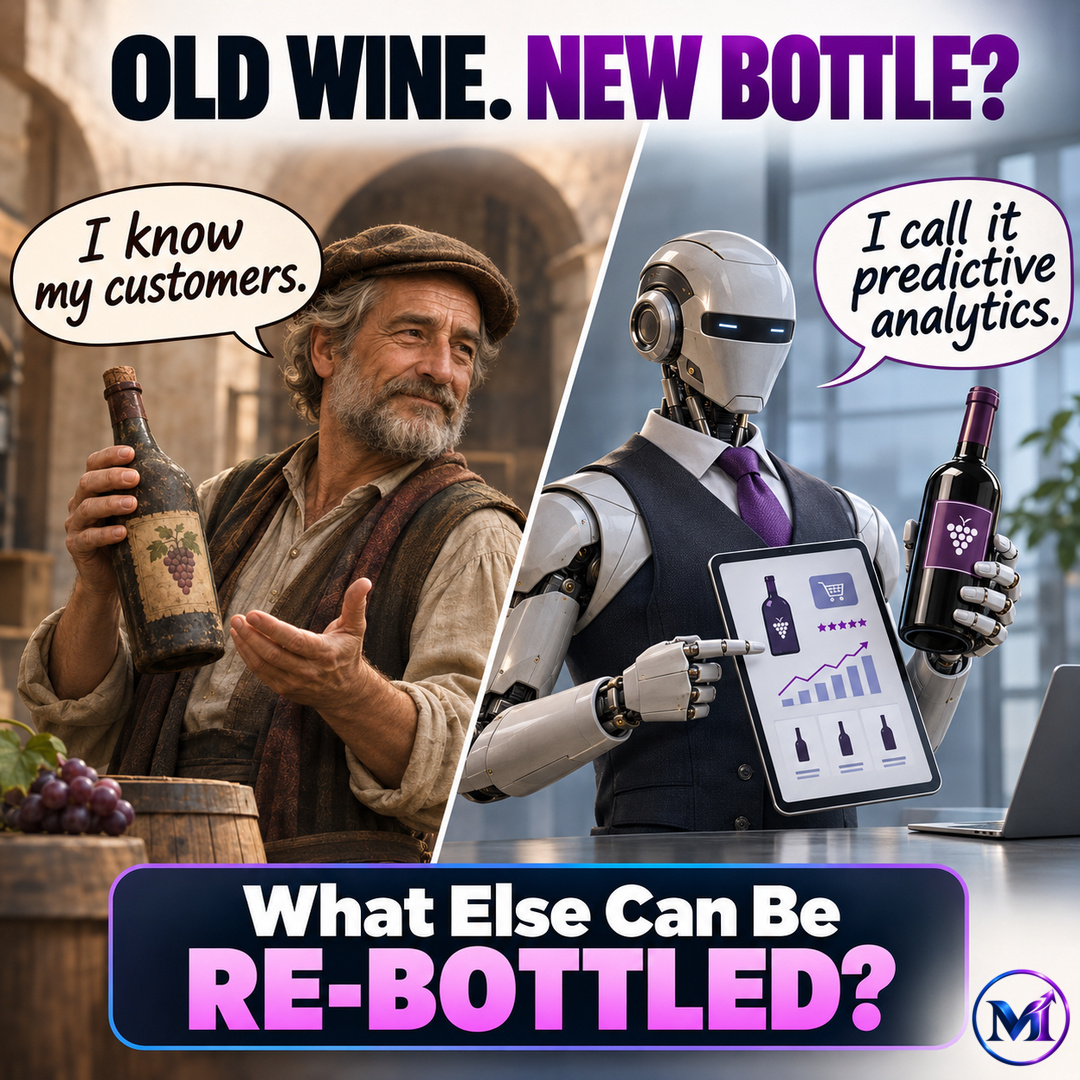
Don’t Invent It. Technify It.
Why your next AI opportunity may be hiding in a very old business practice
At a glance
- Many supposedly new technology ideas are really old business practices with their limitations removed.
- AI can now provide the intelligence behind an application without the business having to build its own AI model.
- AI coding tools can also help create the software itself, lowering the barrier for entrepreneurs who are not programmers.
- For established businesses, the opportunity may be less about “AI transformation” and more about finding one old process that technology can make faster, cheaper or more scalable.
In this article
Walk through a traditional market in almost any tourist destination and something interesting happens.
You ask the price.
The trader looks at you.
He hears your accent. Notices what you are wearing. Perhaps sees the hotel wristband on your arm. He decides how badly you appear to want the item.
Then he gives you a price.
A local resident may be quoted something quite different.
There is nothing remotely new about this. Traders have been estimating what individual customers might be willing to pay for centuries.
Now replace the trader’s judgement with software.
Give it information about browsing behaviour, previous purchases, location or buying patterns.
Suddenly we have what sounds like a thoroughly modern concept:
personalised pricing.
In August 2026, the US Federal Trade Commission invited public comment on a proposed enforcement policy statement about personalised pricing: using personal data to set prices according to what a business believes an individual customer is willing to pay. The proposal focuses on potentially unfair or deceptive practices, especially insufficient disclosure. It does not impose a blanket ban on personalised pricing.
Cutting-edge technology?
Certainly.
Entirely new commercial thinking?
Not really.
It is the old market trader — technified.
Perhaps technology is not always inventing new business
We tend to think of innovation as creating something that has never existed before.
But there may be another route.
Look backwards.
Find a business practice that worked well for decades, perhaps centuries, and ask:
What stopped this from becoming much bigger?
Often the answer is surprisingly mundane.
- It required too much human time.
- It depended on one person’s memory.
- It only worked locally.
- Finding the right buyer or seller was difficult.
- Negotiation took too long.
- Records were manual.
- Coordination became impossible once too many people were involved.
Technology may not need to reinvent the underlying idea.
It only needs to remove the constraint.
That distinction matters.
What does this mean for an established business?
Consider a distributor whose experienced sales manager knows which customers pay promptly, what margins different orders can support and what was quoted last time. That experience is valuable, but difficult to share across a sales team.
Software could bring together past quotations, payment records and product margins to support faster, more consistent decisions. It would not replace the manager’s commercial judgement; it would make the information behind that judgement easier to use.
The opportunity is therefore not to become a technology company. It is to revisit an existing process whose usefulness was constrained by time, memory, access or coordination.
Take haggling
Negotiation is one of the oldest forms of commerce.
A trader says:
KES 10,000.
You say:
KES 7,000.
He counters.
You counter.
Eventually, perhaps, you shake hands at KES 8,500.
Then e-commerce arrived and, strangely, removed most of that interaction.
The internet gave us two choices:
BUY
or
DON’T BUY
But automated negotiation is now bringing some of the old behaviour back.
Nibble, for example, offers AI-supported negotiation tools for procurement, including supplier quotations and commercial terms, within controls set by the business. It illustrates the principle of automating negotiations; the terms and results achieved will vary by application.
So AI did not invent haggling.
It made it possible for a business to haggle with large numbers of customers or suppliers simultaneously.
The bazaar has returned.
Only the trader is now software.
The neighbourhood shopkeeper was doing data analytics too
Think about the traditional neighbourhood shopkeeper.
A good one knew his customers remarkably well.
He knew:
- what they normally bought;
- who always paid promptly;
- who could be trusted with a little credit;
- which customer preferred which brand;
- who normally appeared every Friday;
- and who had not been seen for a few weeks.
He did not call it customer relationship management.
He did not have a dashboard.
He simply remembered.
His problem was scale.
One person may know a few hundred customers exceptionally well.
Software can potentially analyse millions of interactions.
Modern CRM systems, recommendation engines and AI can therefore do something surprisingly familiar:
they help organise and apply some of the information that a very good shopkeeper once carried in memory.
The concept is ancient.
The processing power is new.
Consider the buying club
Neighbours and businesses have pooled their purchasing power for generations.
One family buying ten litres of cooking oil has limited bargaining power.
One hundred families buying a thousand litres collectively have rather more.
The principle is obvious.
The problem has always been administration.
- Someone must gather the orders.
- Collect the money.
- Confirm quantities.
- Find suppliers.
- Negotiate.
- Distribute the goods.
- Keep records.
Technology can automate much of that coordination.
The underlying business idea has not changed at all.
What was once a manually organised buying club could become a continuously operating digital marketplace in which aggregated demand gives buyers greater negotiating power.
Again:
old idea, new scale.
Barter has the opposite problem
Barter is one of humanity’s oldest forms of exchange.
Its weakness is equally old.
I have something you want.
But you may not have something I want.
Traditionally, that kills the trade.
Software can search for combinations that would be almost impossible for individuals to discover manually.
Perhaps:
- I want what Amina has.
- Amina wants what Peter has.
- Peter wants what I have.
The idea of exchanging goods is ancient.
The ability to identify complex chains across thousands of participants is not.
That is another example of an old commercial system becoming interesting again because technology can remove the old constraint.
The pawnbroker had another valuable skill
A traditional pawnbroker could inspect a watch, piece of jewellery, television or tool and quickly estimate:
- what it was;
- its likely condition;
- what someone else might pay for it;
- and therefore how much could safely be lent against it.
That judgement came from experience.
Now imagine taking a photograph of the item.
Software identifies the product.
An AI vision system assesses visible characteristics.
The application checks recent market information and the business’s own pricing rules.
The customer could then receive an indicative valuation or offer.
What happened?
The pawnbroker’s business model did not disappear.
Part of the pawnbroker’s expertise became software.
That does not make the valuation automatically reliable. A photograph may help identify an item, but cannot establish whether it is genuine, stolen or legally acceptable as security. Human verification and controls would still matter.
Five old practices at a glance
| Old practice | Old constraint | Technology-enabled possibility | What to protect |
|---|---|---|---|
| Haggling | One negotiation at a time | Rule-bound automated negotiation | Fairness and transparency |
| Shopkeeper’s memory | Limited to one person | CRM and customer information | Relationships and privacy |
| Buying club | Manual coordination | Digital order aggregation | Reliable suppliers and fulfilment |
| Barter | Hard to match participants | Multi-party matching | Trust and valuation |
| Pawnbroker valuation | Experience and time | Image-assisted initial appraisal | Authenticity and ownership |
- Old practice
- Haggling
- Old constraint
- One negotiation at a time
- Technology-enabled possibility
- Rule-bound automated negotiation
- What to protect
- Fairness and transparency
- Old practice
- Shopkeeper’s memory
- Old constraint
- Limited to one person
- Technology-enabled possibility
- CRM and customer information
- What to protect
- Relationships and privacy
- Old practice
- Buying club
- Old constraint
- Manual coordination
- Technology-enabled possibility
- Digital order aggregation
- What to protect
- Reliable suppliers and fulfilment
- Old practice
- Barter
- Old constraint
- Hard to match participants
- Technology-enabled possibility
- Multi-party matching
- What to protect
- Trust and valuation
- Old practice
- Pawnbroker valuation
- Old constraint
- Experience and time
- Technology-enabled possibility
- Image-assisted initial appraisal
- What to protect
- Authenticity and ownership
And this is where AI changes the equation
Until quite recently, somebody with such an idea faced another problem.
Who is going to build it?
You might need programmers.
Software engineers.
Specialist AI developers.
Servers.
Infrastructure.
Considerable upfront money.
That barrier is falling.
A business building an AI application does not normally have to create its own large language model from scratch.
It can connect its software to an AI provider through an API — essentially allowing the application to send information to an AI model, receive a result and incorporate that result into the service presented to the customer.
The developer pays for the AI that is used.
OpenAI, for example, provides models through its developer platform with usage-based pricing rather than requiring each company to build its own model infrastructure. Image inputs can similarly be analysed through vision-capable models and charged according to usage.
Put more simply:
You can rent the intelligence.
That can change the economics, although integration, testing, security and continuing usage costs still matter.
And you may not have to write all the code either
There is a second development that may prove just as important.
AI can increasingly help build the application that will itself use AI.
Modern coding agents can generate, review, modify and debug software. OpenAI, for example, describes code generation and software-engineering assistance as core uses of its coding systems.
That does not mean professional programmers have become unnecessary.
Real applications still require testing, security, integration, reliability, privacy controls and sound technical judgement.
But it does mean something important for entrepreneurs.
You no longer necessarily need to begin with:
“I have an idea. Now I need to find somebody who can code it.”
You may be able to begin with:
“I understand the problem. Let me build a simple version and see whether the idea works.”
For a younger entrepreneur with limited capital, that is significant.
For an established business owner, it may be even more useful.
You do not necessarily need to launch a major “AI transformation programme”.
You might simply test whether technology can improve one old process.
That may be the real opportunity for established businesses
For CEOs and owners of established companies, the useful question is probably not:
“How do we become an AI company?”
Most businesses do not need to become AI companies.
A more practical question is:
“Which part of our business still works roughly the way it did 20 years ago because changing it was previously too difficult or expensive?”
Perhaps it is:
- quotations;
- supplier negotiation;
- stock clearance;
- customer follow-up;
- credit assessment;
- appointment scheduling;
- purchasing;
- document review;
- matching buyers with sellers;
- answering repetitive customer questions;
- or analysing information that presently sits in several different systems.
These are not glamorous problems.
They may be where time, cash and margin quietly leak.
If technology saves staff time, reduces stock, improves margin, accelerates cash collection or makes customers easier to serve, the project does not need to be revolutionary.
It simply needs to make commercial sense.
For illustration only: if two employees each spend three hours daily preparing quotations, that represents six staff-hours a day. Reducing preparation time by one third would release two staff-hours daily for checking exceptions and serving customers. Whether that translates into a financial benefit depends on accuracy, workload and implementation costs.
Start with the business practice, not the AI
This may be where many businesses get the sequence wrong.
They begin with:
“We need to use AI.”
Then they search for something for AI to do.
Try reversing the process.
Look at the business first.
Identify something that works — but only because somebody spends considerable time, memory, judgement or effort making it work.
Then ask:
If technology removed that limitation, what would become possible?
That is a rather different way of approaching innovation.
And it leads to another question:
What did an excellent trader, shopkeeper, broker, buyer, accountant or salesman do 50 or 100 years ago that technology could now do at scale?
That may be a surprisingly fertile place to look for the next business opportunity.
Not everything should be technified
There is an important qualification.
An old practice may also contain an old problem.
Return to our market trader.
When everyone knows that bargaining is taking place, negotiation is transparent.
If software quietly charges different customers different prices because it has analysed their personal behaviour, the issue becomes more complicated.
Customers may reasonably want to know how such decisions are being made.
That is precisely why regulators are examining personalised pricing and the use of personal data in setting prices.
Technology amplifies good practices.
It can amplify bad ones too.
So the question is not merely:
Can this be technified?
It should also be:
Should it be?
And:
Does it create genuine value for the business and its customer?
There is another risk: some traditional practices work precisely because they are personal. The neighbourhood shopkeeper did more than remember transactions; he built trust. Technology should preserve what customers value, not merely remove what appears inefficient.
Processes using personal data also need appropriate legal and privacy safeguards. Kenya’s Data Protection Act and the UK GDPR require lawful processing where applicable; consent is not the only possible lawful basis. Credit decisions and lending may introduce further regulatory responsibilities.
Look backwards before looking forwards
Somewhere inside an old marketplace, shop, warehouse, purchasing department or office may be a practice that has survived for decades because it works.
It may still depend on:
- memory.
- judgement.
- matching.
- negotiation.
- coordination.
- repetition.
Those happen to be areas where software and AI can increasingly provide leverage.
The next useful business application therefore may not begin by asking:
“What completely new thing can AI invent?”
It may begin with a much simpler question:
“What already works — but has never been able to scale?”
Then do not necessarily reinvent it.
Technify it.
Five questions before you technify
- Does the process happen often enough for improvement to matter?
- What does it currently cost in time, errors, delay or lost opportunities?
- Are the relevant records and decision rules available and sufficiently reliable?
- What might go wrong — including lost trust, privacy, compliance or expensive errors?
- Would the likely benefit justify implementation and ongoing costs?
Start with one small, measurable test. Compare the new approach with the existing process before expanding it.
Could one of your old processes be a new opportunity?
If your business still has a process that depends heavily on manual judgement, repeated negotiation, spreadsheets, individual memory or time-consuming coordination, it may be worth examining whether technology can simplify it.
I can help you identify the commercial problem, challenge the idea, define what a practical first version should achieve and assess whether it is worth pursuing before substantial money is committed.
Sources and further reading
- US Federal Trade Commission, “FTC Seeks Comment on Enforcement Policy Statement Regarding Personalized Pricing,” 19 August 2026. https://www.ftc.gov/news-events/news/press-releases/2026/08/ftc-seeks-comment-enforcement-policy-statement-regarding-personalized-pricing
- Nibble, official product information on AI negotiation for procurement. https://nibbletechnology.com/
- UK Information Commissioner’s Office, “A guide to lawful basis” (updated 2 April 2026). https://ico.org.uk/for-organisations/uk-gdpr-guidance-and-resources/lawful-basis/a-guide-to-lawful-basis/
- Kenya Data Protection Act, 2019 (statutory framework; application depends on circumstances).
Looking for an independent perspective on business performance, strategy or systems improvement?
© 2026 Murtaza Insights
More from Information Systems & Process Improvement
Information Systems & Process Improvement · Last updated: 2 November 2026
From Paper to ERP—and Everything in Between: Where Can AI Help?
From handwritten records to full ERP, examine where AI can reduce manual work, improve controls and help management get more useful answers from existing information.
Read ArticleMore Insights

Business Analysis & Strategy · Published: 7 November 2026
Should Your Budget Be Based on Your Ambitious Sales Target?
How boards can preserve ambitious growth targets without compromising financial discipline, accountability or liquidity.
Read Article
Business Analysis & Strategy · Last updated: 13 October 2026
Quickmart IPO: Valuation, Returns and Investment Risks
Quickmart is growing, profitable and attracting major investors. But at KSh7.50, does the potential return justify the risks? A closer look at the valuation, dividends, growth plans and IPO structure.
Read Article